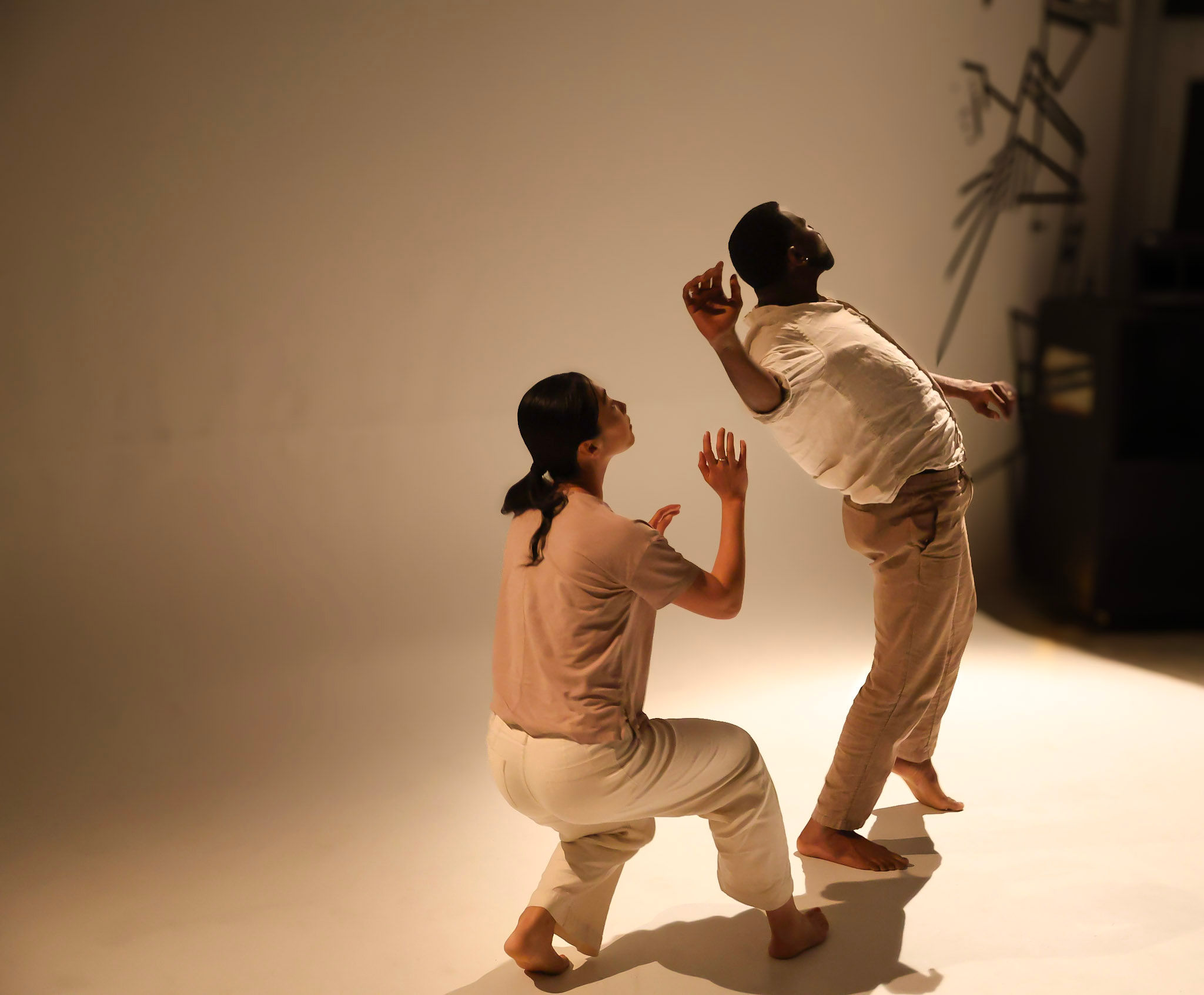
MAY 28, 2026: American Dance Festival launched their 2026 performance season with an homage to and reimagining of an iconic post-modern choreography by David Gordon. Wally Cardona and Molly Lieber reinvigorated David Gordon’s (1936-2022) post-modern dance choreography TIMES FOUR originally set in 1975. Interpreting written notes, videos, and aural records from 1976, Cardona and Lieber expanded upon TIMES FOUR with a similar precision that Gordon originally used to create the dance. Entitled TIMES FOUR 1975/2025, this intimate studio performance on May 28th was a mental and muscular marathon combining aspects of the original 15 movement phrases created in 1975 with 32 new phrases created in 2025 by Cardona and Lieber.


Cardona and Lieber unceremoniously entered American Dance Festival’s Scripps Studios through a side door, and, in what felt like moments later, left just the same. Save for exactly four moments where they slumped onto the floor in a cannon, they walked, pivoted, stomped, jumped, and slid in exact unison for the uninterrupted 70-minute runtime. Walking no more than a few steps at a time – forwards, backwards, diagonally – they moved carefully throughout the studio, sometimes close to one another, sometimes far. The dancers repeated each phrase to each corner of the room in various relationships to one another, but the seemingly simple choreography quickly became a complicated challenge of focus.
TIMES FOUR 1975/2025 is the type of work that challenges dancers. Complex orientation changes and just enough variation in phrasing could discombobulate even the highest of professionals. One misstep would have broken the illusion. But Cardona and Lieber’s trance-like performance transformed this recipe for disorder into an impressive feat of concentration and stamina. Executed without musical accompaniment, the dancers relied on peripheral observation of one another, breath queues, and an internal metronome, which can only be explained by a deep understanding of the original work, hours of tireless rehearsal, and great interpersonal chemistry.
“In 1975, the original Times Four was performed by David Gordon and Valda Setterfield in their studio at 541 Broadway in New York City. The year before he died in 2023, David talked to me about doing Times Four and asked me who I’d like to perform it with. My answer: Molly Lieber. Though it never came to fruition while David was alive, two years after his death, Molly and I began the process of preserving and building on the few existing fragments on record from the 1975 version, imagining a Times Four into the future.” – Wally Cardona
In this refreshing performance, TIMES FOUR 1975/2025 presented what many of us have forgotten in modern dance: choreographic systems. While each specific dance position was relatively simple to execute, the broader picture painted by the dance was a strikingly complex masterclass in choreographic mapping. American Dance Festival’s staff handed out copies of Gordon’s original choreographic notes.

The notes featured writings in black, red, and blue ink — likely as a result of editing or revisiting the choreography on a different day. What’s clear in the notes is that Gordon’s approach to this piece was not purely expressive. It was logical and puzzle-like. Each position and its parts were carefully considered. The point of the piece was to create a living system, not display dancers with distinct voices.
“In my work an activity cannot exist without its echoes and each echo must stand alone as a complete action. The repetition of any given act clarifies it, determines its necessity and changes it from an arbitrary or capricious act to an inevitable one.” – David Gordon, featured excerpt in Whitney Museum of American Art, NYC 1976 performance program (link)
Learn more about TIMES FOUR on davidgordon.nyc
Thank you, American Dance Festival for featuring Cardona and Lieber’s homage to Gordon’s legacy.